Ask five companies what a customer success manager does and you'll get five different job descriptions, most of them with "drive value" somewhere in the first line. That isn't much help if you're thinking about moving into the role or hiring for one.
This guide walks through what a customer success manager actually does: the work that fills the week, the numbers the role answers for, how it differs from account management and support, and how AI is already changing the job. It's written for people new to customer success, though experienced CSMs should find a few things worth arguing with.
A customer success manager (CSM) makes sure customers get the result they bought a product for, so they stay and spend more over time. In practice, that means onboarding new customers, getting their teams to use the product, spotting accounts at risk well before renewal, finding room to grow, and carrying customer feedback back to the company.
Why the customer success role exists
Customer success grew out of a change in how software gets sold. When companies bought software once and owned it forever, the vendor got paid up front, and whatever happened after the sale was mostly the customer's problem. Subscriptions changed that. A customer on a yearly plan can walk away at every renewal, so most of the money a customer will ever pay arrives after the first contract is signed.
That puts the vendor in an awkward spot. The sale proves the customer wanted the product, but it says nothing about whether they'll ever get value from it, and a customer who never gets value eventually leaves. Somebody has to own the distance between "we bought it" and "it's working for us," and that person is the customer success manager.
A personal trainer is a useful way to picture the job. A gym member pays for a result, usually getting stronger or losing weight, and the trainer can't lift the weights for them. What the trainer can do is set a plan in the first few sessions, check progress every week, notice when the member starts skipping Tuesdays, and change the plan before the member quietly cancels. If the member sees results, renewing the membership is an easy decision, and they might book extra sessions or bring a friend along.
A CSM does the same work for a business customer. The customer's team has to change how they work, and the CSM makes sure that effort turns into the result they paid for.
The five core responsibilities of a customer success manager
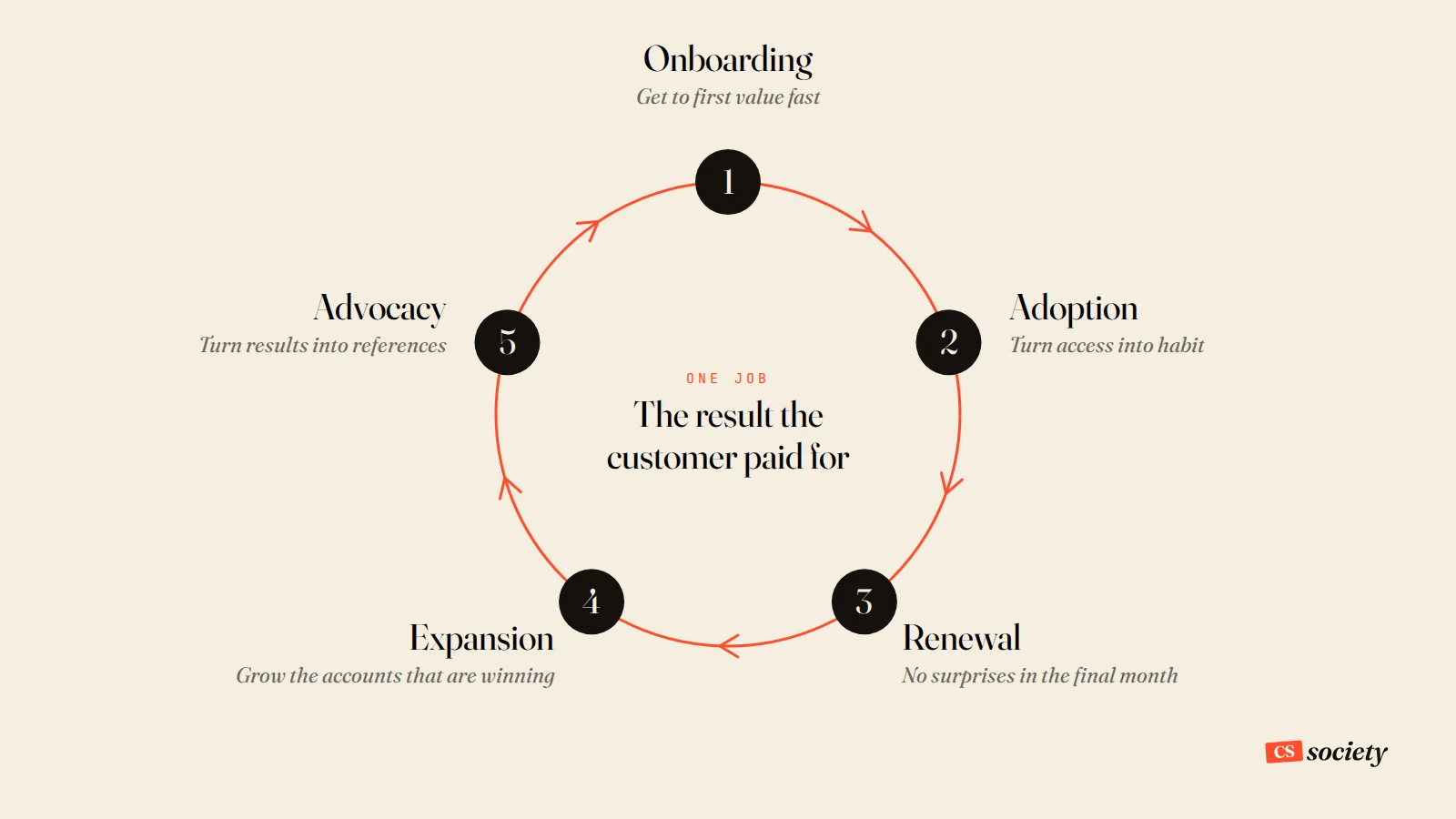
Most CSM work falls into five areas. They overlap, and the mix shifts with the size of the accounts, but nearly every CSM job description is some version of these.
1. Onboarding: getting to first value fast
Onboarding is the stretch between a signed contract and the first time the customer gets something real out of the product. The CSM runs the kickoff, agrees on goals with the customer, plans the setup, and chases whatever is blocking it, whether that's a login integration nobody configured or a data import stuck in someone's queue.
Speed matters because excitement fades. The people who pushed to buy the product are at their most motivated in the first few weeks, and a slow start hands the doubters inside the customer's company an easy argument. A good CSM also reads everything sales learned before the deal closed, so the customer never has to explain their goals twice.
2. Adoption: turning access into habit
Buying seats is easy; getting people to change how they work is the hard part. Adoption is the CSM's effort to get the right people using the right parts of the product often enough that it becomes part of their routine.
That means watching usage by team and by feature, running training for groups stuck on old workflows, and sharing what similar customers do well. A CSM who only looks at total logins will miss most of the story, because ten people logging in to export one report is a very different account from ten people running their whole week in the product.
3. Renewals: no surprises in the final month
For many CSMs, the renewal is the number that matters most. The best renewals are boring, since the customer has seen results all year and the decision maker already knows what the product is worth.
Getting there means starting early. A CSM tracks renewal dates months ahead, checks whether each account is healthy, and raises risk while there's still time to fix it. Some companies give the CSM full ownership of the renewal; others split it with an account manager or a renewals team. Either way, the CSM's work during the year decides most of the outcome, and work done in the final month is mostly damage control.
4. Expansion: growing accounts that are already winning
Expansion means the customer buys more: extra seats, a higher plan, a second product, or a rollout to another team. CSMs often see the signs first because they're closest to how the customer uses the product. A team that keeps hitting its seat limit, a new department asking for access, or a customer describing a problem the product happens to solve are all expansion signals.
Whether the CSM closes that deal or passes it to sales depends on the company, but the order doesn't change. Expansion follows results, and pushing an upsell on an account that isn't getting value yet is a fast way to lose the renewal too.
5. Advocacy and the voice of the customer
Happy customers can do things no marketing team can, like speaking at an event, writing a review, or taking a reference call from a nervous prospect. CSMs know which customers are happy and when it's a good moment to ask, so they usually run these requests.
The CSM also carries information the other way. They hear what customers struggle with, which features they keep asking for, and why some of them leave. A CSM who brings that back to product and leadership in a clear, organized way is worth far more to the company than one who only reports a renewal rate.
What a customer success manager's week looks like
The five areas above are the job on paper, and the week itself is messier. The balance depends on whether a CSM looks after a few large accounts or many smaller ones.
Work What it looks like Why it matters Customer calls Check-ins, training sessions, quarterly business reviews and the occasional fire drill Calls are where risk and opportunity usually surface first Account reviews Reading usage, support tickets and notes for each account Problems tend to show up in the data before anyone says them out loud Renewal prep Building the case for value months before the contract date A renewal decided in the last few weeks is usually a renewal at risk Internal escalations Getting a bug fixed or a feature request heard by the right team The customer sees the CSM as the company, so the CSM has to move the company Admin Updating the CRM, writing call notes, logging follow-ups Work that isn't written down is lost when an account changes hands Hard conversations Price increases, missed promises, unhappy executives Trust gets built in the calls nobody wants to take
One honest note: admin eats more of the week than most job descriptions admit. That's a big part of why AI matters so much to this role, which comes up again below.
Customer success manager vs account manager vs customer support
All three roles talk to customers, so people mix them up constantly. The simplest way to tell them apart is to look at what each one is waiting for.
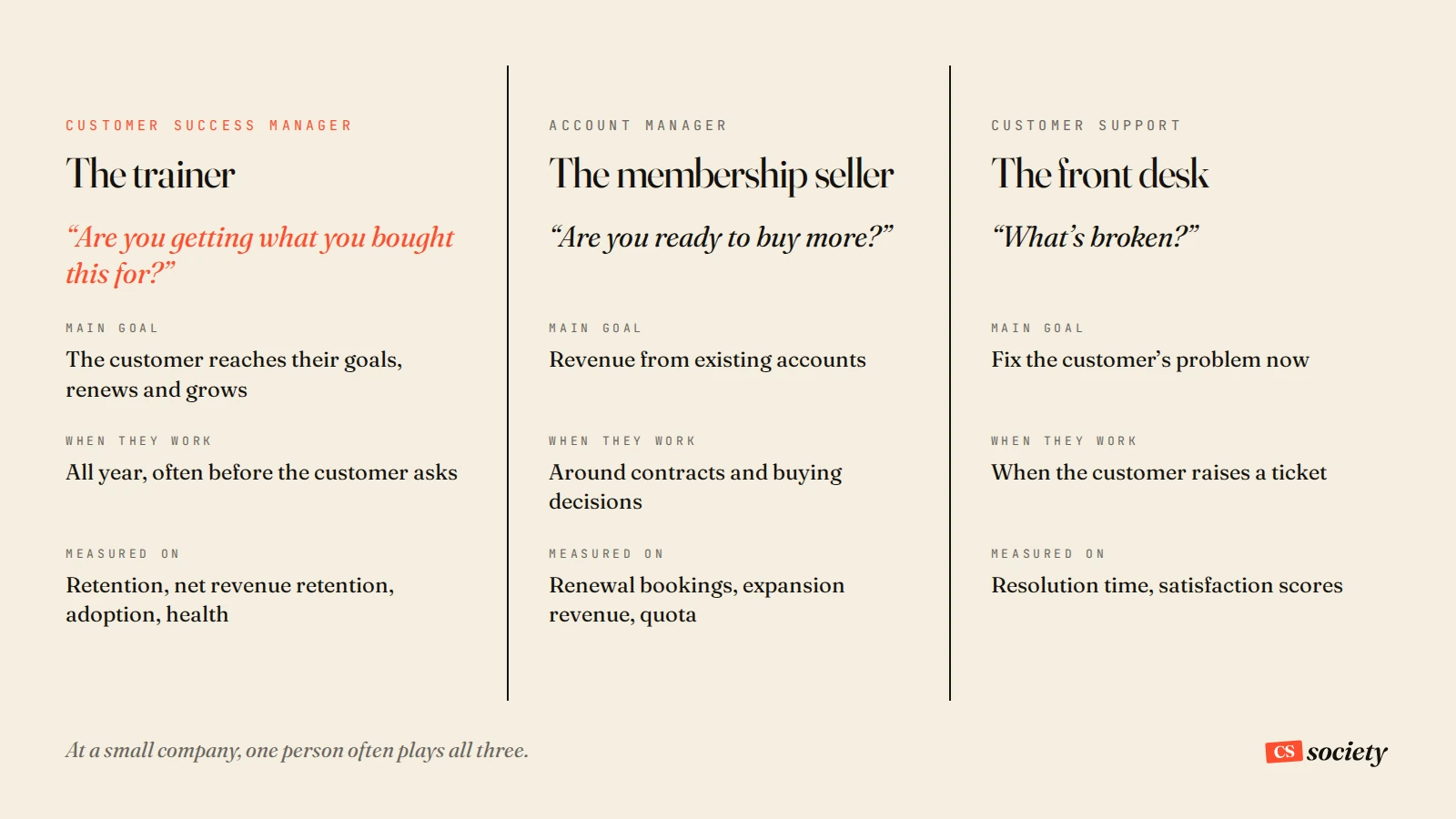
Customer success manager Account manager Customer support Main goal The customer reaches their goals, renews and grows Revenue from existing accounts Fix the customer's problem now When they work All year, often before the customer asks Around contracts and buying decisions When the customer raises a ticket Measured on Retention, net revenue retention, adoption, health Renewal bookings, expansion revenue, quota Resolution time, satisfaction scores Typical question "Are you getting what you bought this for?" "Are you ready to buy more?" "What's broken?"
Back at the gym, support is the front desk that fixes your broken locker, the account manager sells you the premium membership, and the trainer is the one making sure you actually get fit. At smaller companies one person often does all of it. The roles still call for different instincts, so it helps to know which one you're playing on a given call.
The numbers a customer success manager is measured on
A CSM's performance shows up in a handful of metrics. Not every company tracks all of them, but most CS teams use some mix of these:
- Gross revenue retention (GRR): the share of revenue kept from existing customers after churn and downgrades, with expansion left out. It can never go above 100%.
- Net revenue retention (NRR): the same calculation with expansion added back in. Anything above 100% means existing customers are growing faster than you're losing them.
- Churn rate: the share of customers or revenue that leaves in a given period.
- Health score: one score per account that combines signals like usage, support tickets, survey answers and engagement. Every company builds its own formula.
- Time to value: how long a new customer takes to get their first real result.
Here's how NRR works with simple numbers. Suppose a CSM's accounts start the year at $100,000 in annual revenue. Over the year, customers add $15,000 through expansion, $5,000 disappears through downgrades, and $10,000 churns. NRR is ($100,000 + $15,000 − $5,000 − $10,000) ÷ $100,000, which comes to 100%. GRR ignores the expansion, so it's ($100,000 − $5,000 − $10,000) ÷ $100,000, or 85%.

Health scores deserve one warning. A score is only as good as the signals behind it, and a green score on an account whose champion resigned last week shouldn't reassure anyone. Good CSMs use the score to decide where to look, then go and check for themselves.
The skills that make a good customer success manager
CSMs come from support, sales, teaching, consulting, operations and plenty of other places. The background matters less than a few skills that show up in nearly every strong CSM:
- Commercial sense. Understand how the customer's business makes money, so you can connect the product to something their boss cares about.
- Product depth. Know the product well enough to suggest a better workflow before the customer thinks to ask.
- Clear writing. Follow-up emails, executive summaries and account notes that the next person can actually use.
- Reading data. Spot a drop in usage or a pile-up of tickets, and ask why it happened.
- Comfort with hard calls. Tell a customer something they won't like, and stay calm when an executive is angry with you.
That last skill is the hardest to learn.
How AI is changing what a customer success manager does
A lot of CSM time goes into work that AI now handles well: summarizing calls, reading through support tickets, writing first drafts of follow-up emails, pulling usage numbers for a quarterly review, and watching dozens of accounts for early warning signs. None of that was ever the reason a company hired a CSM. It was the tax on the job.
As AI takes over more of that work, the job moves toward what software is bad at: reading a tense room during a renewal call, knowing which single metric the customer's new VP actually cares about, deciding whether a dip in usage means trouble or a team on holiday, and telling an executive their rollout is off track in a way that gets them to act.
Two things follow. CSMs whose week was mostly admin and status updates will find less of their job left, and that risk is real. And CSMs who are good with people, sharp with numbers and comfortable making judgment calls will get to spend far more of their week on exactly that, across more accounts than they could handle before.
Our view at CS Society is simple: AI raises the bar for the CSM role. The judgment, the relationships and the commercial calls were always the valuable part of the job, and now they're most of it.
Where the customer success manager role leads
Customer success now has a real career ladder. A common path starts at customer success associate or junior CSM, moves to CSM and then senior or enterprise CSM, and leads into team lead, head of customer success, VP of customer success, and chief customer officer roles. Plenty of CSMs also move sideways into account management, sales, product or operations, because the job teaches you how customers really use a product.
So, what does a customer success manager do?
A customer success manager makes sure customers get what they paid for, early and clearly enough that renewing is an easy decision. Everything else in this guide, from onboarding to health scores to the way AI is reshaping the week, serves that one job.
If you already do this work, or you're trying to break into customer success, you don't have to figure it out alone. CS Society is a vetted community of customer success practitioners who share what's working, talk through hard accounts and help each other find the next role. Apply to join CS Society for member-only research, our curated customer success jobs board, and a floor full of people who do this job every day.
Frequently asked questions
What does CSM stand for?
CSM stands for customer success manager in most business and software contexts. It's the person who helps customers get value from a product after they buy it. In agile software teams, CSM can also mean Certified ScrumMaster, a certification for scrum masters, so check the context when you see it in a job post.
Is a customer success manager a sales role?
Partly. Most CSM jobs have a commercial side, even though the role starts after the sale. Many CSMs own renewals or spot expansion opportunities, and some carry a quota for upsells. Sales wins the customer, while the CSM keeps them and helps them grow, which only works once the customer is getting results.
Do you need a technical background to become a customer success manager?
No, most CSM roles don't require a technical degree. You do need to learn the product deeply and explain it in plain language, which is easier if you're comfortable with software. Some companies, especially those selling developer tools or data products, prefer technical CSMs, so read each job description closely.
How many accounts does a customer success manager handle?
There's no standard number. It depends on how much revenue each account brings in and how much attention it needs. A CSM covering large enterprise customers might look after a small group of accounts, while a CSM covering smaller customers can manage hundreds, using emails, webinars and automated check-ins to reach most of them.
What is a book of business in customer success?
A book of business is the set of customer accounts a CSM is responsible for, usually described by the number of accounts and their total annual revenue. A CSM's retention and expansion numbers are calculated across their book, so a CSM who "owns a $2M book" looks after accounts that add up to about $2 million a year.
Can you become a customer success manager with no experience?
Yes, though most people start one step below the CSM title. Common entry points are customer success associate, onboarding specialist, or a support role at a software company. Experience in teaching, consulting, hospitality or account management also transfers well, because the core skills are explaining things clearly and keeping people happy over a long relationship.
Is being a customer success manager stressful?
It can be, mostly around renewals and escalations. A CSM often stands between an unhappy customer and an internal team that can't fix the problem quickly, and that pressure is real. The stress drops a lot when risk shows up early, so CSMs with good visibility into their accounts and a supportive team tend to find the job far more manageable.